Section 2.2 – Spanish Exploration & the Birth of St. Augustine
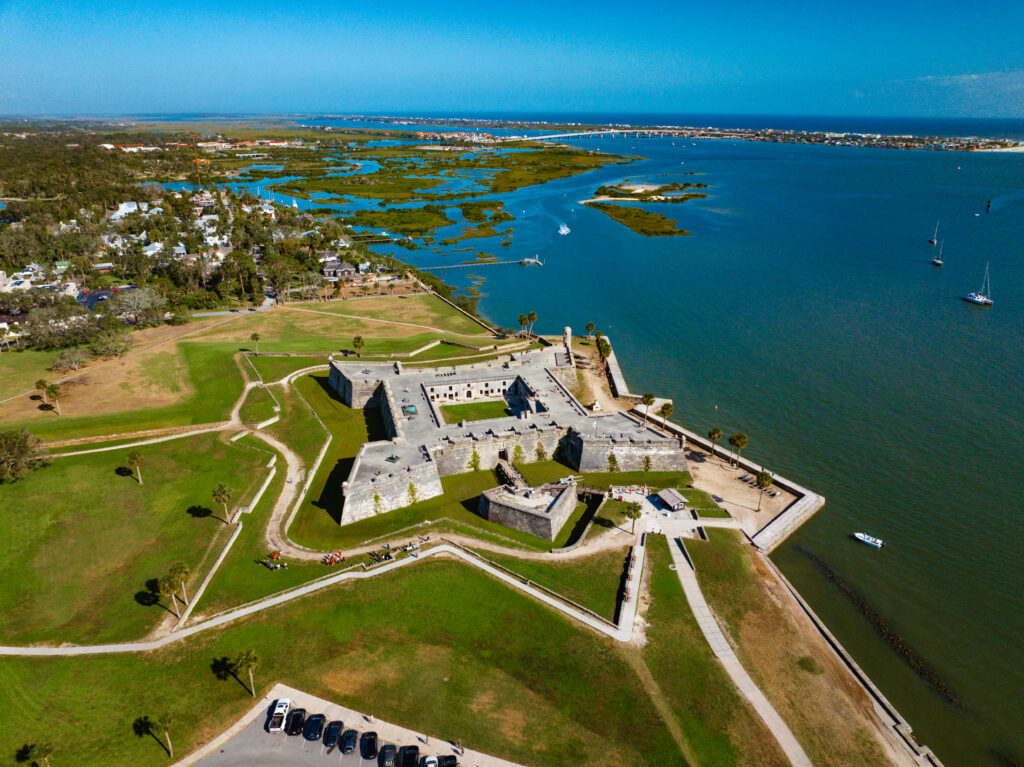
Castillo de San Marcos in St. Augustine, the oldest masonry fort in the continental United States, stands as a powerful reminder of Florida’s Spanish colonial past. Photo courtesy of Emergent Media.
The Spanish colonization of Florida began in April 1513 with the arrival of Spanish explorer Juan Ponce de Leon, who landed on the northeast coast of the land he called “La Florida” for its lush appearance and because it was the Easter season’s Pascua Florida (“Feast of Flowers”).
Visitors explore Castillo de San Marcos in St. Augustine, where centuries of Spanish colonial history come to life along the waterfront. Photo courtesy of Emergent Media.
Ponce de Leon’s initial landing was followed by a parade of galleons from Spain, whose expedition leaders established colonies on opposite ends of North Florida in what are now Pensacola and St. Augustine. Although the Pensacola settlement was technically first, the St. Augustine colony, founded in 1565, holds the distinction of being the longest continually inhabited European-founded city in the United States.
The former Hotel Ponce de Leon, now Flagler College, showcases the grand Gilded Age architecture that helped shape Florida’s early tourism industry. Photo courtesy of Interpret Studio.
With its historic forts, homes and buildings, including the Oldest Wooden Schoolhouse, a visit to St. Augustine will transport your clients back to colonial Spain. It’s not an exaggeration to say the city is in a state of constant heritage celebration with historic reenactments, storytelling and impressive attractions and historic sites, from the Fountain of Youth to Aviles Street—oldest street in the Oldest City—and the imposing Castillo San Marcos, oldest masonry fort in the continental United States. Closer to the present day, the legacy of Standard Oil magnate Henry Flagler—whose Florida East Coast Railway opened the state to tourism—is seen in his original Gilded Age architecture, especially the palatial Hotel Ponce de Leon, now Flagler College.
We use cookies on our website to give you the most relevant experience by remembering your preferences and repeat visits. By clicking “Accept All”, you consent to the use of ALL the cookies. However, you may visit "Cookie Settings" to provide a controlled consent.
This website uses cookies to improve your experience while you navigate through the website. Out of these, the cookies that are categorized as necessary are stored on your browser as they are essential for the working of basic functionalities of the website. We also use third-party cookies that help us analyze and understand how you use this website. These cookies will be stored in your browser only with your consent. You also have the option to opt-out of these cookies. But opting out of some of these cookies may affect your browsing experience.
Necessary cookies are absolutely essential for the website to function properly. These cookies ensure basic functionalities and security features of the website, anonymously.
Cookie
Duration
Description
cookielawinfo-checkbox-analytics
11 months
This cookie is set by GDPR Cookie Consent plugin. The cookie is used to store the user consent for the cookies in the category "Analytics".
cookielawinfo-checkbox-functional
11 months
The cookie is set by GDPR cookie consent to record the user consent for the cookies in the category "Functional".
cookielawinfo-checkbox-necessary
11 months
This cookie is set by GDPR Cookie Consent plugin. The cookies is used to store the user consent for the cookies in the category "Necessary".
cookielawinfo-checkbox-others
11 months
This cookie is set by GDPR Cookie Consent plugin. The cookie is used to store the user consent for the cookies in the category "Other.
cookielawinfo-checkbox-performance
11 months
This cookie is set by GDPR Cookie Consent plugin. The cookie is used to store the user consent for the cookies in the category "Performance".
viewed_cookie_policy
11 months
The cookie is set by the GDPR Cookie Consent plugin and is used to store whether or not user has consented to the use of cookies. It does not store any personal data.
Functional cookies help to perform certain functionalities like sharing the content of the website on social media platforms, collect feedbacks, and other third-party features.
Performance cookies are used to understand and analyze the key performance indexes of the website which helps in delivering a better user experience for the visitors.
Analytical cookies are used to understand how visitors interact with the website. These cookies help provide information on metrics the number of visitors, bounce rate, traffic source, etc.
Advertisement cookies are used to provide visitors with relevant ads and marketing campaigns. These cookies track visitors across websites and collect information to provide customized ads.