Section 2.1 – Indigenous Civilizations & Early Cultural Foundations
Mission San Luis in Tallahassee recreates a historic Apalachee-Spanish settlement, offering insight into Indigenous life and early colonial influence in North Florida. Photo courtesy of Visit Florida / 500px.
Shaped by overlapping histories—including the indigenous Timucua and Apalachee tribes, the colonial influence of Europe, cultural traditions from Africa and the antebellum South—North Florida’s heritage feels older and more layered than much of the state.
Living history demonstrations at Mission San Luis in Tallahassee recreate daily life in an Apalachee-Spanish settlement, offering visitors a glimpse into North Florida’s early cultural heritage. Photo courtesy of Visit Florida.
Beginning with the oldest legacies, both the Timucua and Apalachee nations had complex civilizations that were ultimately decimated, relocated or absorbed into the Spanish mission system following the European conquest. What remains can be seen at several historical sites, including the Mission San Luis in Tallahassee, a reconstructed Apalachee-Spanish site including more than 950,000 artifacts; the Lake Jackson Mounds, once a major Apalachee ceremonial center; the Mission San Martin de Timucua, also referred to as Fig Springs, located in Ichetucknee Springs State Park; and remnants of Potano village sites scattered across Alachua County.
The crystal-clear waters of Ichetucknee Springs flow through landscapes once inhabited by Indigenous communities, connecting natural beauty with deep historical roots. Photo courtesy of Visit Florida.
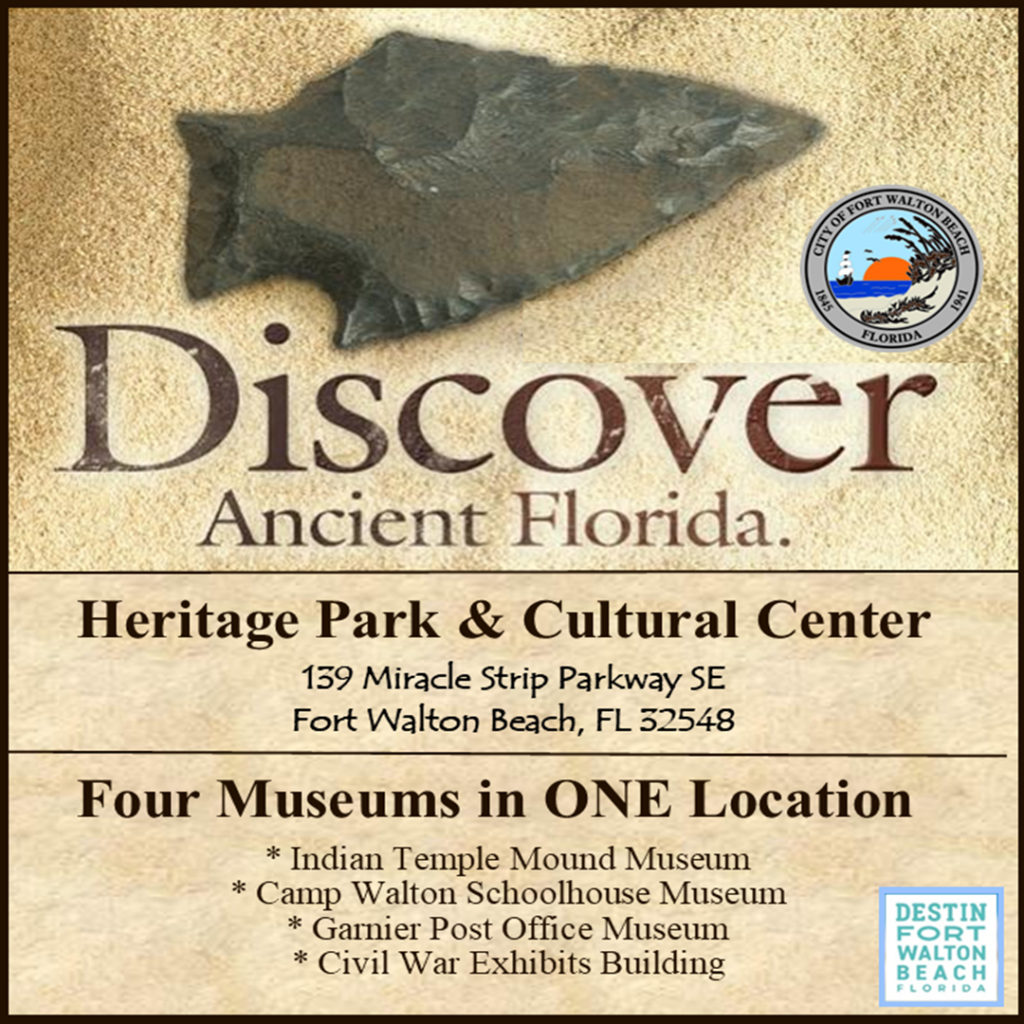
In the coastal town of Fort Walton Beach, the Heritage Park & Cultural Center is expanding its Indian Temple Mound Museum, which contains thousands of artifacts made of stone, bone, clay and shell, dating as far back as 12,000+ years ago. The multi-museum complex includes the Fort Walton Temple Mound, built by indigenous peoples between 800-1500 CE and designated a National Historic Landmark.
Sponsored Content
Ancient Florida History in the Heart of Downtown Hours: Tuesday to Saturday 10:00am to 3:00pm.
The City of Fort Walton Beach Heritage Park & Cultural Center is a multi-site complex representing 12,000 years of Florida’s Panhandle history.
This property is home to the Fort Walton Temple Mound, a National Historic Landmark and archaeological park. Built around AD800 by the prehistoric people who once lived in a village that extended along Santa Rosa Sound, it stands as a watchful sentinel above the Indian Temple Mound Museum.
This museum shares the technological, artistic, and spiritual achievements of the prehistoric Native Americans whose villages marked this region. The artifact gallery features interpretive exhibits from prehistoric Native American cultures, European and Colonial exploration, and the golden age of piracy around Fort Walton Beach. The museum experience includes a Museum Store filled with items from the indigenous cultures of North America.
The Camp Walton Schoolhouse (1912)is a restored two-room school used in Camp Walton, later known as Ft. Walton Beach, from 1912-1936. It houses exhibits from the early history of the town when it was called Camp Walton. See what education was like when the three R’s were taught to the tune of a hickory stick.
The Garnier Post Office Museum (1918) is a two-room post office that was used until 1956 when rural routes closed it for good. The museum houses artifacts from Camp Walton, stamps, postal materials, and celebrates voting precinct #19.
Civil War Exhibit showcases local and regional Civil War history. This exhibit features the battles of Santa Rosa Sound and Olustee, secession, slavery, prisoners of war, Western theater, and the First Florida Brigade.
We use cookies on our website to give you the most relevant experience by remembering your preferences and repeat visits. By clicking “Accept All”, you consent to the use of ALL the cookies. However, you may visit "Cookie Settings" to provide a controlled consent.
This website uses cookies to improve your experience while you navigate through the website. Out of these, the cookies that are categorized as necessary are stored on your browser as they are essential for the working of basic functionalities of the website. We also use third-party cookies that help us analyze and understand how you use this website. These cookies will be stored in your browser only with your consent. You also have the option to opt-out of these cookies. But opting out of some of these cookies may affect your browsing experience.
Necessary cookies are absolutely essential for the website to function properly. These cookies ensure basic functionalities and security features of the website, anonymously.
Cookie
Duration
Description
cookielawinfo-checkbox-analytics
11 months
This cookie is set by GDPR Cookie Consent plugin. The cookie is used to store the user consent for the cookies in the category "Analytics".
cookielawinfo-checkbox-functional
11 months
The cookie is set by GDPR cookie consent to record the user consent for the cookies in the category "Functional".
cookielawinfo-checkbox-necessary
11 months
This cookie is set by GDPR Cookie Consent plugin. The cookies is used to store the user consent for the cookies in the category "Necessary".
cookielawinfo-checkbox-others
11 months
This cookie is set by GDPR Cookie Consent plugin. The cookie is used to store the user consent for the cookies in the category "Other.
cookielawinfo-checkbox-performance
11 months
This cookie is set by GDPR Cookie Consent plugin. The cookie is used to store the user consent for the cookies in the category "Performance".
viewed_cookie_policy
11 months
The cookie is set by the GDPR Cookie Consent plugin and is used to store whether or not user has consented to the use of cookies. It does not store any personal data.
Functional cookies help to perform certain functionalities like sharing the content of the website on social media platforms, collect feedbacks, and other third-party features.
Performance cookies are used to understand and analyze the key performance indexes of the website which helps in delivering a better user experience for the visitors.
Analytical cookies are used to understand how visitors interact with the website. These cookies help provide information on metrics the number of visitors, bounce rate, traffic source, etc.
Advertisement cookies are used to provide visitors with relevant ads and marketing campaigns. These cookies track visitors across websites and collect information to provide customized ads.